
Walt Disney World
1971-present


Being a tiny bit older than Walt Disney World, and growing up right on the edge of its property line, it would have been possible or even likely that I wouldn't be fascinated by the place, since it was ever-present and constantly accessible. Living next to the Walt Disney World Village, where we could have easily walked to from our front door, was as normal to my brother Brian and me as it was for us to likewise live within walking distance of a Stuckey's or Interstate 4. What ended up happening, however, was that we both developed slow-burn obsessions with Disney - from the parks to the hotels to the movies to the TV shows. So between 1971 and 1977 we went from casual Disney-adjacent children to kids who wanted to spend all of their free time on Disney property. And that was, of course, easy to do.
Why it turned out that way vs. going in a different direction has been a lingering question in my head. The best answer I could come up with so far is that Brian and I perceived over time just how different WDW was from the rest of the world we spent time in, and we very much loved the former. Of course so did millions of other people, young and old, from around Orange County, Florida, the USA overall, Canada, Mexico, Europe and sometimes even further away. The immensity of WDW combined with its level of execution, thoughtfulness and artistry ... for it to just pop up over the course of just a five-year planning and construction period was remarkable. To have this start to dawn on us and then learn more about not just how the resort came to be, but then also learn about Walt Disney himself and the team of talented people who designed and opened "Phase One," was mind-boggling for not-quite-ten-year-olds. And then of course there was the Magic Kingdom which, even if it had never been more than 1/4 of its 1975 reality, would have still had enough rides, shows and other stuff to hold us in its perpetual sway.
There was something more to it, though, that I suspect was subconscious at first. It was a sense of belonging, when we there, that exceeded the "rightness" of any other place we spent time outside of maybe our paternal grandparents' house. Walt Disney World treated us so well, was so warm and friendly even when we boarded or exited the more frightening rides, or just spent time in the hotel game rooms (our grandfather would take us to the hotels on weekends when our mother wasn't taking us to the Magic Kingdom or EPCOT Center) or ran through the shops at the Village. It was the polar opposite of the austere church that we were taken to three times a week, with old German people looking down on us literally, figuratively and trying to correct our behavior. Disney was constant waves of affirmation.
And there was something even more to the something more: Walt Disney World rewarded the amount of attention paid to it. I loved Yogi Bear before I loved Disney because the first themed place in Orlando that I was taken to endlessly was the Jellystone Park Campground on Turkey Lake Road (1969-2000), but after about two trips to the ranger station I knew I'd seen the place. How many trips to the Magic Kingdom would it take before a 1970s kid would know they'd seen all of it? Quite possibly they wouldn't get to the saturation point. I mean, this was the first theme park in the world where a genius like Rolly Crump designed an attraction, Mr. Toad's Wild Ride, that not only wasn't a "copy" of the Disneyland original but had deliberately different scenes on each of its two tracks. I was a teenager before I could say for certain which scenes lived where. And I was an adult working at the ride before I could say I'd looked at each scene from every angle. Now I'm an old man who still has to double check his photos and video to make sure I'm remembering the stuff correctly. No kid with the slightest amount of imagination would find themselves immune to the magic and mysteries of such a wonderland.
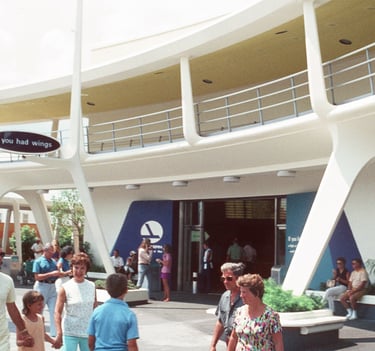
So we were hooked. If WDW hadn't affected Brian and me so heavily at such a young age, we might not have seen the changes that unfolded over its first 20 years of operation as equal parts exciting and sad, or stopped to wonder what was going on when The Mickey Mouse Revue closed in 1980 and was relocated to Tokyo Disneyland, or felt the loss of If You Had Wings in 1987 as the gut punch it turned out to be. And that sent me from being a teenager who'd made a few audio recordings and taken a few photos at WDW in the early 1980s to being an adult who worked at WDW and tried to document a ton of things and then started writing about all of it.
The main premise behind Widened World (when it began as Widen Your World) was that Walt Disney World was once the most amazing man-made attraction on the planet, with the greatest amount of cool stuff in one physical place weighed against the least amount of mediocrity mixed in.
The second thought at play here is that WDW's apex, with the most successfully integrated configuration of all its components and the least number of critical elements missing, was sitting between 1971 and 1996. Its aura in the 1970s, especially, was distinct and crisp and experienced by the least number of people who can still remember it today. It had fewer attractions but more cohesion. Clean beyond belief... almost sparkling. Aesthetically maintained, directly, by some of WED Imagineering's finest hands for the first few years. It changed in many ways, but that very early version of WDW finally started to get more nostalgic love from Disney itself starting in the 2010s. By the 2020s it was embraced fully by fans who grew up with WDW, the company and younger fans who took full advantage of the many new avenues for learning more about the early days of the Vacation Kingdom of the World.
The main focus of Walt Disney World, from its conception, was that which would lie beyond the borders of the Magic Kingdom. The original five year plan did not include or even forecast for the distant future a second theme park, but it did call for a variety of resort hotels and recreational activities geared toward commanding up to a week of vacation time. Starting with just two hotels, the Contemporary and the Polynesian, and the Fort Wilderness campground for the October 1, 1971 opening, accommodation options were limited until the opening of the Golf Resort Hotel and the Motor Inn Plaza hotels at Lake Buena Vista in 1973. Additions came gradually and were placed in relative accordance with the master plan that had been in place before even the WDW Preview Center opened in 1970. Likewise, activities ranging from boat rentals and horseback rides to golfing and tennis were introduced at the offset, and were further enhanced in measured paces with additions such as Treasure Island, later Discovery Island, in 1974, the Walt Disney World Village in 1975 and River Country in 1976.
No one closely involved in the original plans for WDW could have predicted the direction that the resort would take after the Eisner & Wells management team arrived in 1984. After a quick glance at the property's usage up to that time, the new leaders set about to aggressively expands on opportunities for more profitable development in Florida. By 1987, planning and construction were underway for a dizzying mix of new hotels, entertainment complexes and water parks. The company has yet to stop and catch its breath aside from a brief spat of Covid epidemic in 2020. Compare a property road map from the early 1980s with a map printed since 1994; The original scope of WDW looks like an exercise in understatement.
In the course of this full-tilt expansion, it was inevitable that a number of original features would be done away with or at least dramatically adapted to the needs of the new master plan. Similarly, some elements from the original plan that had yet to reach the construction phase were moved from the "postponed" file to the "probably never" file.
So there is just as much content for recollections and obituaries outside the gates of the parks as within. What a place!

All written content on the site is by me, Mike Lee, except where both in italics and attributed. No writing on the site was created in whole or in part by AI. It's okay for people to use my writing for their own projects, but I appreciate attribution. If someone takes my writing and puts their own copyright on it, they will not be the first to pass that way. As for images, the site is A) my own photos or art, B) from official / corporate sources or C) individuals. If a source is "anonymous," it's either because the photographer was unknown (often the case with old photos purchased online) or when someone asked to remain unnamed. If someone asks to be named but only sends images of Harvey Birdman, that's out of bounds.