
Regardless of whose pen each flowed from, the concept sketches led to another of WED's magnificently intricate and fully-painted scale models, covering all of the attraction's 31 show scenes. This was an art form that artists such as Harriet Burns, Fred Joerger and Ken O'Brien in the Model Shop had brought to miniature perfection in the 1960s. Although the handcrafted artistry of modelmaking never lost its appeal or went away at WED, computer modeling and sheer economics made the dimensionality, scale, level of color and detail seen in those earlier models an increasingly scarce sight as later parks and attractions were developed. The EPCOT Center models, fortunately, were well documented in pre-opening materials such as books and postcards.
Construction on World of Motion, as well as the sculpting process for its battalion of animatronics (most requiring entirely new production vs. re-use of old molds and tooling) began in 1979. The statistics involved with the undertaking are impressive:
Building Dimensions: 55' height, 320' diameter
Ride System: Omnimover, 141 on 47 separate platforms - in groups of three vehicles per platform
Track Length: 1,750 feet
Ride Length: 14-1/2 minutes
Hourly Capacity: 3,240
World of Motion yielded great construction and in-development photos. By May of 1982 the pavilion was nearing completion, according to the April 30, 1982 issue of WDW cast newsletter "Eyes and Ears," and the sight of immense props like railroad cars and classic automobiles being hoisted through the open sides of the building by crane had been published in The Orlando Sentinel, Orlando-Land magazine and several national periodicals. Video footage of the man in the stagecoach poking his head in and out of the window was being shown virtually any time someone did a televised report on EC's progress.
World of Motion opened to the public on EPCOT Center's official opening date of October 1, 1982, but experienced operational problems such as the ride system starting and stopping repeatedly throughout the day. The narration by Laugh-In announcer Gary Owens also dropped in and out of the ride vehicles, mid-sentence, for no apparent reason. These problems were mostly resolved by month's end, however, and World of Motion became one of the most heavily-visited and popular attractions in the park.
Occupying the same southeastern quadrant of Future World as the Odyssey Restaurant and Communicore's EPCOT Poll, World of Motion was approached by guests from the north or west on main Future World pathways just as Test Track was still being accessed in 2011. The glass-covered outer surfaces of the circular building constituted the near-whole of its exterior, framing the entry alcove which featured one central support pillar wrapped by the ride's first section of track. Guests could clearly see that this was a slow-moving experience as they walked into the open space, with the blue Omnimover vehicles twisting clockwise from the ground floor up to the second level and entering a contoured hole in the red wall - where the ride's show scenes began*. In the background, a sixteen-minute loop of instrumental music putting twists on the pavilion's theme song, It's Fun To Be Free by Buddy Baker and X. Atencio, echoed off the walls and blue tiled floor. As with its predecessors like If You Had Wings and It's A Small World, the entire attraction featured variations on this upbeat theme, making it hard to pinpoint one version as the "official" take. In this courtyard area, the arrangement was predominantly symphonic, with diversions into jazz, swing and country time signatures.
* This was the best pavilion entrance at EPCOT Center. Seeing the ride track twist up through that open space was irresistible.
World of Motion (page barely started)
1982-1996


"Ride through the evolution of transportation and see just why 'it's 'fun to be free'' " - 1982 EPCOT Center Guide
For thirteen years, General Motors' World of Motion contained within its circular walls some of the most fondly-recalled elements that EPCOT Center and Walt Disney World ever had to offer. That included the largest cast of animated figures (most counts put it at 140) ever used in a single Disney attraction combined with detailed sets, a massive array of projector effects, distinctively lighthearted music and the versatility of the Omnimover ride system to illustrate a comical history of man's quest to "travel from here to there" by increasingly efficient - and expedient - means. Scene by scene, each mode of travel revealed itself to have inherent risks or limitations up through the automobile. A brief look at a city of the future led to the TransCenter post-show, where guests walked through a variety of exhibits geared toward the future of automotive travel and mass-transit systems.
A Transportation Pavilion was one of the earliest original planned elements of EPCOT Center, going back to the company's 1975 annual report when the concept for a "Future World Theme Center" was first publicly floated out by WED Enterprises (Walt Disney Productions' design & engineering arm, later known as WDI) as a complement to the just-slightly-older plans for a "World Showcase." By that time, the 1966 plans for EPCOT as an actual city had been definitively tabled by Card Walker, president of WDP, in favor of what was quickly becoming a two-parks-in-one approach. The proliferation of the term pavilions in the company's descriptions of EPCOT was a solid indicator that this new development would be fleshed out World's Fair-style, as were the concept renderings and models being produced at WED. After the work Disney had done for the Ford Motor Company, Pepsi-Cola, General Electric and the State of Illinois at the 1964 New York World's Fair, the men and women of WED were clearly familiar with what it took to make entertaining landmark attractions tailored to the needs of well-heeled sponsors.
This time they were going to make one for General Motors. GM's involvement came about largely because of a chance meeting between WED's Bob Gurr and GM's head of design, Bill Mitchell, at a 1976 art school dedication in Los Angeles. The "Big Three" automaker entered into discussions with Disney that year (its interest mentioned in WDP's 1976 annual report) and they signed a sponsorship agreement on the last business day of 1977, making GM the first official EPCOT Center participant. The first published art labeled for the Transportation pavilion in the 1977 annual report was also the last to resemble later art created for Horizons (with a more futuristic urban slant than anything related to cars). GM's nearly-concurrent involvement was likely a key factor in the change of direction. At the 1964 World's Fair, GM had sponsored Futurama II, the Fair's most popular exhibit. This fact was not lost on WED Enterprises, whose four shows had been close runners-up, and they intended to deliver an even more compelling presentation for GM in Florida. But whereas Futurama II had focused on futuristic habitats on the moon, under the sea, in the jungle and enmeshed within modern cities*, GM's EPCOT Center pavilion would be more squarely focused on the evolution of transportation and, before the experience was completed, tie that in directly with modern-day GM cars and prototypes.
Claude Coats - a veteran Disney Studios artist and one of Widened World's heavyweights - did a large amount of design work on early versions of the Transportation Pavilion. GM reportedly wanting something a little more Disney i.e., a little more fun. And this is where World of Motion's history hits a fork in the road. If you would have spoken to anyone from Disney at the time of EPCOT Center's opening, they'd have told you that their longtime animator Ward Kimball was the loony genius who infused World of Motion with its requisite humor. And if you had read any of the newspaper or magazine articles published about the park back then, you'd have come away with that same impression. The only problem with that story - one I'd read and believed for seventeen years - is that it wasn't exactly true. Kimball DID work on World of Motion, but he was not a one-stop-shopping maverick that brought the attraction around from its c. 1978 presentational origins to the gag-laden, dioramic banquet that opened to the public in 1982. That credit belongs largely to Marc Davis.
Like Kimball, Davis was a key Disney animator with many iconic character designs (including Tinker Bell and Maleficent) under his belt. He had joined WED in 1963 and in the ensuing ten years would be, along with Coats, one of the two artists most responsible for defining what constitutes a "classic" Disney attraction, namely the signature blend of humor, staging and animatronics found in Pirates of the Caribbean and the Haunted Mansion. Davis had retired from WED in 1978, but was approached by the company almost immediately afterward to provide material for the General Motors pavilion. His notoriously prolific work ethic led to dozens of renderings for GM, among them were the above rendering of an octopus wrapped around a shipwreck, a vintage plane flying low over a farmer milking a cow (causing the cow to run away), a caveman carrying a bear on his back, an overcrowded streetcar and a man in a hot air balloon with birds swarming toward him.
That Davis would have come up with a lot of material is no surprise. What's noteworthy is that much of his art was translated almost verbatim into an attraction for which Kimball was brought in to do further work, and for which Kimball received press coverage. WOM's crocodiles ready to nip the toes of the man on the raft, the paintings of watercraft projected behind that scene, the Chinese man being pulled in a rickshaw, the bull holding up a steam coach ... all of these and many more find their genesis in Davis's work; some were used without revision. I was fortunate enough to see a lot of this art during a 1999 interview with Davis, his wife Alice and Ross Plesset, which is how I learned of Davis's involvement with the ride. Although not present in his notebook at the time, Davis said he had also conceived of the pavilion's showpiece scene, "the first traffic jam" - in which a motorist has shattered a horsedrawn produce cart on a busy city street and caused backups in all directions. It's a piece that Marty Sklar, former vice-president of WDI, incorrectly attributed to Ward Kimball in Jeff Kurtti's 2008 book Walt Disney's Imagineering Legends.
Having seen some of Davis's work on WOM and little of Kimball's, for me the record suggests a possible Ken Anderson/Sam McKim/Haunted Mansion-style chicken or the egg situation surrounding two very talented and extremely deceased individuals. Davis's work on WOM did start coming to light publicly c. 2005 in some books and articles, while more recent accounts of Kimball's role have characterized him as a "consultant."** As such, did he suggest the traffic jam scene's final configuration that moved the panicked horse to the foreground? Were some of the ride's scenes entirely of Kimball's own doing? And where is his WOM artwork hiding if we've seen that of Davis and other WED personnel such as Ken O'Connor? I can't figure it out, but somebody else will; a 2010 blog post by Didier Ghez stated that someone had bought a box of Kimball's WOM artwork on ebay and might build a website around it. That would certainly help answer some questions.
* This Futurama subject matter became the springboard for everything WED was to do with General Electric's EPCOT Center attraction, Horizons, with its colonies in space, underwater cities and desert farms. Horizons ended up sitting right next to World of Motion in Future World East. It's tempting to characterize that as irony, but it seems almost deliberate.
** Kimball may have been to some extent playing a public relations-type role as an intentional move by WDP management. Kimball reinforced EPCOT Center's ties to the time of Walt and, by inference, lended the park additional credibility. John Hench served a similar purpose at the time by virtue of not just having worked directly with, but also by resembling Walt Disney to a certain extent. And if there's any one result WDP management was seeking from EPCOT Center in 1982, apart from people coming to see it, it was to convince the world that Walt's last/greatest dream was realized.


The ride opened to the public on June 5, 1972. Eastern Airlines and Walt Disney Productions officials formally unveiled the attraction during a dedication ceremony the following month, on July 2.
If You Had Wings would be the last Omnimover ride Disney would build for over ten years. The next would be General Motors' World of Motion attraction which opened with EPCOT Center in October 1982. That ride and its neighbor, El Rio del Tiempo at the World Showcase Mexico Pavilion, would both draw heavily from the same technologies used at length in If You Had Wings. The similarities will be outlined later in this text. In spite of the extensive borrowing by those latter attractions, If You Had Wings was largely overlooked in terms of receiving post-opening promotion from the company. Pictorial souvenirs produced between 1972 and 1987 only featured a photo of the ride once, in 1986. The attraction was not represented on postcards, view-master reels, 16mm films or even latter-day VHS tapes that offered Magic Kingdom overviews. Even the nearby Mission To Mars was accorded a higher level of coverage throughout the 1970s and 1980s.
But If You Had Wings persevered from the standpoint of popularity. Even after the A-E ticket system was disbanded in 1982, it remained one of the few rides in the park that people eagerly chose to visit repeatedly during the same day. If someone went through Mission To Mars more than once on the same day, it was probably a mistake. If You Had Wings, on the other hand, was just too fun to ride only once.
Most of the time a ride's successful ability to draw visitors ensures its long-term prospects, in other instances it has no bearing at all. In the case of a sponsor-dominated attraction like If You Had Wings, the solvency of Eastern Airlines became the governing factor in the ride's destiny. When Frank Lorenzo bought Eastern in 1986, the company was in dire financial straits. On the eve of bankruptcy and dissolution, Eastern opted not to renew its fifteen-year sponsorship of If You Had Wings and continue its status as the official airline of WDW. Disney was faced with the decision to either keep the attraction down for the busy summer season while developing a replacement or to come up with a temporary fix that would keep the ride running and buy time to court another sponsor. They went with the second option, which turned out to be the best choice given that the summer of 1987 saw record highs - both in Central Florida temperatures and in park attendance.
If You Had Wings closed on the first of June 1987. Five days later it reopened as If You Could Fly. On paper the changes look slight, but in practice they made for a genuinely a different attraction. In addition to the name change reflected in the exterior signage, the Eastern logo was replaced by the stylized image of a seagull. Seagulls already figured prominently in the attraction, so it was an easy icon to fall back on.
In the load area, the orchestral background music was replaced by an instrumental version of the new If You Could Fly song and the boarding announcements were silenced. The Eastern jet was, of course, pulled from the side of the globe. At the beginning of the ride, the change in music became even more apparent. Where the chorus of singers once intoned "If You Had Wings" there were new voices, reminiscent of the queue area duet at EPCOT Center's Horizons. The lyrics - "If you could fly on seabird wings, and feel the joy that freedom brings, those dreams you had when you could fly will soon be realized through seabird eyes..." were kind of unappealing (implying that you could literally be turned into a bird and using its eye sockets) and the production value was mundane i.e., it didn't exactly fit the ride. Each successive scene's music had been replaced with something different, contrasted with the original segments, lacking. In terms of audio, only the sound effects (voices of the couple in the straw market, bursting fireworks, etc.) were retained.
If You Could Fly was still a visually rich experience, but it could be difficult to enjoy for anyone who loved If You Had Wings. Without the song, Eastern or the voice at the end of the ride ("You do have wings"), the "soul" of the original and its actual reason for being was gone. This sad fact made the transition from If You Could Fly to a new attraction, Dreamflight, just a little more tolerable.
If You Could Fly closed January 4, 1989. In the months that followed, just about everything surrounding the tracks was broken down into pieces small enough to be carted out of the ride in portable grey waste bins. As the summer approached, a new ride began taking shape where If You Had Wings once stood.
Dreamflight, sponsored by Delta Airlines as the new official airline of WDW, opened to the public on the 23rd of June. An overview of the changes:
The once open Holding and Load areas were subdivided into three different sections replicating a neon-laden airport boarding area with a plane section visible through the glass. The sections of the ride from the globe up to Mexico City became three-dimensional scenes rendered in pop-up book style referencing the early days of flight. The massive room that had once encompassed Mexico, the Caribbean and Puerto Rico was now sectioned off into three chambers, the first being the pop-up book cartoons. The second was a big room with a single screen upon which was projected a film of a stuntman riding atop a biplane. The third was where the mannequin phase of the ride began. It started in San Francisco where a plane called the Global Clipper sat in the harbor. A couple on the dock looked out across the water and the plane's captain sat frozen at his dining table as if he'd found himself on the menu. In what was once the Puerto Rican fort, large dioramas of a Japanese countryside and Paris held more mannequins, albeit with some attractive scenery. New Orleans was replaced by a jet engine through which the cars passed on their way to the held-over Speed Room. The seven original films were replaced by a computerized "future runway" scene that was shortly removed in favor of some flight-through-the clouds footage. The Mirror Room remained as well, but the mirrors were taken out. Now the cars faced off to the right where another movie screen showed even more computer-generated vistas. The Descending Flight scene was now where a huge pop-up book bounced back and forth between recreations of London and New York. All the music had changed as well, with tailored versions of a new theme song playing throughout the entire ride.


Dreamflight, while disjointed to an extent, drew plenty of visitors and operated until June 1996, six months after Delta dropped its sponsorship of the attraction. Then the name changed to Take Flight. It was exactly the same as Dreamflight save for the removal of some Delta logos and some extremely minor changes in two pieces of music. That would have been a replay of what happened with If You Had Wings and If You Could Fly if not for the fact that the changes to Dreamflight didn't actually make the ride measurably less than its original self.
In January 1998, Take Flight closed and the attraction was made over as Buzz Lightyear's Space Ranger Spin, which opened in October of that same year. Buzz Lightyear used the same ride vehicles with some new additions (laser guns), the same track and the same overall room structure. Everything else was changed.
Although If You Had Wings evolved from Adventure Thru Inner Space, it did retain the distinction of having passed along a few new things to some other Disney attractions. Unfortunately most of those attractions have already gone the way of If You Had Wings. The first thing If You Had Wings loaned out was the Speed Room / Super Speed Tunnel idea, which landed on the second floor of Disneyland's America Sings in 1977 as an addition to the Peoplemover (which ran through the Carousel Theater building's second floor). This application went on to feature scenes from the company's 1982 film, TRON. The Peoplemover closed in 1995, however, and its replacement, the also-now-closed Rocket Rods, did not make use of the Speed Room.
When Epcot opened in 1982 (as EPCOT Center), many of its attractions could be likened to If You Had Wings in terms of their ride systems, pacing and sponsorship agreements. But two rides at Epcot Center echoed If You Had Wings more obviously - World of Motion and El Rio del Tiempo.
World of Motion began in a manner very similar to If You Had Wings: a large, open holding area leading to a load platform where guests boarded blue Omnimover cars that slowly approached a dark, semi-foreboding portal. World of Motion also had not one, not two, but THREE Speed Rooms near the end of the ride. The first was almost identical to If You Had Wings' version in that its films were extremely similar. For example, one World of Motion scene was of bobsleds shooting down an icy run. Another was a fast-paced underwater jaunt. The second Speed Room featured swirling light effects and a fiery inferno, the third was footage from TRON, just as in Disneyland's Peoplemover. If only Buzz Lightyear's Space Ranger Spin used some TRON images as a tribute to early computer-generated imagery, the circle would be complete. World of Motion closed in January 1996 and its replacement, GM's Test Track, did not have the Speed Room components. Nor did it have the Omnimover cars. Or the great animatronics. Or a fun theme song. But it had crash-test dummies and a better ending.
The Mexico Pavilion's boat ride, El Rio del Tiempo, which operated in its original form until January 2007. It reopened in April 2007 as the Gran Fiesta Tour, which introduced the title characters from Disney The Three Cabelleros film to the ride. The ties to If You Had Wings here were more numerous before the ride's reinvention but several echoes remained. First, the boat ride incorporates a large early Mexican pyramid, as did If You Had Wings. Secondly, the floating gardens of Lake Xochilmilco were kind of recreated in El Rio del Tiempo, albeit somewhat distinctly from the If You Had Wings version (in that there's some real water in the boat ride). Both rides contain depictions of downtown Mexico City. And they both rely heavily on the use of projected images to achieve motion. Another strong connection was that If You Had Wings and El Rio del Tiempo both had infectious theme songs created for the rides that could easily echo in visitors' heads for hours after exiting. Gran Fiesta used the Three Caballeros theme to a similar effect.
What really tied the two rides together, though, were some of the original filmed scenes. Mexico's attraction had footage of people cavorting on beaches just as If You Had Wings did. Mexico had street merchants trying to pass off handcrafted wares to guests passing by, just as If You Had Wings had merchants pushing goods in the Caribbean Straw Market. And If You Had Wings had a projection of cliff divers plunging in Acapulco, just as Gran Fiesta did in a modified form. The merchant footage in El Rio del Tiempo was removed when Gran Fiesta came in and the beach depictions were significantly changed, but for as long as Gran Fiesta operated, WDW visitors could still get a taste of what If You Had Wings was like.

If You Had Wings - Scene By Scene
If You Had Wings occupied the space in Tomorrowland that is now the home of Buzz Lightyear's Space Ranger Spin. As with some of its neighbors from years past, CircleVision 360 and Mission To Mars, If You Had Wings had a relatively unremarkable exterior. It consisted of an identifying sign pylon, white concrete walls and a dark blue angular portal that framed the glass door entryway. Seen below to the left in a Spring 1972 photo, IYHW had a WEDway track above its entrance a full three years before the WEDway Peoplemover opened (July 1975). IYHW's doorway was flanked by a set of wall signs, dimensional letters and Eastern logos that changed slightly over the ride's years of operation. The entrance was usually staffed by a cast member known as a greeter.
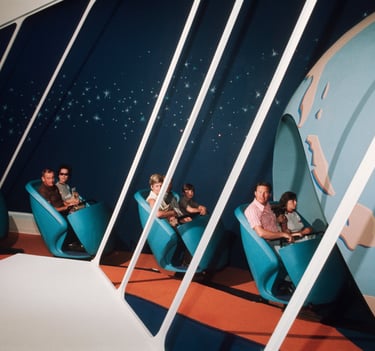
Once guests passed through the open doorway, they entered what Eastern Airlines described as "a spacious, modern airport passenger terminal." This vast room, also known as the Holding Area, had high ceilings, sparkling white walls and luxurious blue carpeting (orange for the ride's first couple of years, as shown in an adjacent photo). At the far side of the room was the Load area, where guests stepped onto a Speedramp and took a seat in one of 102 continuously-moving Omnimover vehicles. These ocean blue cars trailed off to the north side of the room, where they entered an oversized and elongated globe through a gaping hole. Attached to the side of the globe for much of the ride's lifespan was a model of an Eastern jet, heading west. The sight of the cars passing into this sphere was exciting and a little ominous, as what lie beyond the darkness of the globe's interior was anyone's guess. From the entrance to the load point, a twisting queue area was recessed into the center of the room. Guests passed by large backlit signs for arriving and departing flights, which blinked exotic destinations such as "Bahama's 100,000 Islands" and "The Magic Kingdom." Echoing throughout the holding area was a lush orchestral arrangement based on the main theme of Eastern's "Airbus" commercials. Periodically played over this theme was the voice of a man* announcing a series of arriving and departing flights..."Eastern Airlines announces the departure of flight 811, Whisperliner service to the underwater reefs of Bermuda."
A 1972 Eastern publication proudly stated that Orson Welles, who had done voiceover work on the airline's TV ads, would also lend his voice to the queue area. Although multiple sources (people who either worked at the ride in its first years or visited as adults and trust their memories) have confirmed that Welles' voice did appear in the attraction in the early years, no one could find a recording for all the looking years between, for me, 1991 to 2026. That's when Eric Paddon found a 1975 audio recording on the Internet Archive and could make out the voice of Welles where all other live recordings (from 1976 forward) had featured a different voice. That voice sounded like to me like Disney Studios mainstay Peter Renaday (also Renoudet), who provided the voice-over on a "demo tape" of the ride as well as voices for several other Magic Kingdom attractions. My former Haunted Mansion co-worker Marc Sheffield confirmed, shortly after Eric confirmed the Welles voice, that the next voice was Renaday. Renaday's name was on the audio feed tapes in the Magic Kingdom's DACS control room.
When guests reached the end of the queue, they were guided onto the Speedramp by a host or hostess and split into Omnimover-car sized groups, typically 2 adults per vehicle. From here on out they cruised forward at a rate of two feet per second, steadily approaching the big hole in the globe. This hole, incidentally, was situated just south of Florida, throwing guests smack into the middle of the Caribbean, which was the approximate center of Eastern's more celebrated vacation routes.
The ride began with guests disappearing into darkness. The black walls of the globe's interior came alive with the white silhouettes of seagulls in flight. The persistent whirr of the ride's 16 millimeter film projectors snuck up out of nowhere and the ride's theme was introduced by a gleeful chorus of unseen singers. This simple song, written by Buddy Baker and X. Atencio, became a favorite for many Magic Kingdom visitors - "If you had wings, you could do many things, you could widen your world, if you had wings...If you had wings, if you had wings, if you had wings, had wings, had wings, had wings..." Repetitive to the point of absurdity, making it all the more memorable.
As the ride vehicles spun inside the globe, the seagulls on the wall turned into jet airplanes racing off to exciting destinations. These silhouettes faded into the background as guests approached their first destination, Mexico. The cars faced off to the right of the ride's forward motion, and the track began a climb through the room. Spread out before the guests was a vision of old Mexico, brought to life by a series of two-and-three dimensional props, film projections, lighting and sound effects. Rising from a sea of geometric cloud formations was an Aztec pyramid basking in the rays of a blazing stylized sun. In the distance were the cliffs of Acapulco, where a series of divers took the breathtaking plunge every few seconds. Soon the cars swung over to the left. As they did, guests were confronted by a large stone dragon's head, a representation of the Aztec god Quexalcoatl.
To their left, guests faced a panorama of modern Mexico. Flower-laden boat drifted across the shimmering floating gardens of Xochilmilco, carrying dancers and a Mariachi band that blared the ride's theme from their trumpets. In the sky above, projections of pottery and other crafts rose from the horizon and flew through the sky. Further along was a main plaza of Mexico city, where the shadows of festival-goers frolicked in the distance. Closer to guests, through the open arches of a downtown building, dancers in fiesta regalia spun across the floor.
By this point in the ride, If You Had Wings' maddening acoustics could be fully appreciated. The first half of the ride took place in one large room divided into different areas by three-dimensional props. This resulted in a blending of all the scenes' musical tracks and created a nice messy din. So it was hard to pick apart the song lyrics for any given area. These lyrics are, however, included below in Part III. The music was a key element of the attraction, its one quick melody tying together many otherwise unrelated segments. In this essay, however, the music is only mentioned in brief. Suffice it to say that each area had its own background music whether guests could hear it or not. In Mexico, it was the sound of a Mariachi band.
All sense of motion in the attraction - beyond that of the actual ride vehicles - was achieved through the use of film and effects projectors. By and large the ride's backdrops served as framing for projected images. There were no moving props or animated figures, but the ride was still very "alive." This was due in large part to Claude Coats' gift for staging. His talents gave the ride a strong sense of atmospheric plausibility.
After passing below the dragon's head, the cars descended into a Caribbean seaport. To the right was an ocean liner, inventively dubbed the "Caribbean Cruiser," preparing to set sail. Passengers lined the railings of the boarding deck, waving and throwing streamers. A steel drum band played in their midst. In the harbor below, a slew of smaller watercraft dotted the horizon. The image of a dancing couple was silhouetted against the sail of small sloop. Down in the water, divers groped through the kelp for treasure.
At the water's edge, in a shack marked "Sport Fishing," a tourist posed proudly with his catch (a swordfish of indeterminate proportions) while his wife set up to snap a picture. As the man stood there beaming, the fish hanging next to him grew larger and smaller, evidently illustrating the vast difference between what he'd caught and his own biased impression of it.
The cars turned left again and entered a straw market. In a small building decorated with all manner of hand-woven goods was another couple, who tried to make a sale (in time with the music) to passing guests. "Wanna buy a sombrero," the man inquired, "made of real fine straw? How about a nice handbag, for pretty mama?" His wife sat beside him, eagerly trying to unload a hat. The straw market scene then gave way to Puerto Rico, as the cars swung back to the right and began another slow incline. Through tropical foliage guests viewed a group of young people doing the limbo. Then the battlements of San Juan's Castillo San Felipe del Morro rose around the track. Through archways guests had aerial views of the seacoast and the fort, with now-familiar seagulls passing by. In another arch was a musical group fronted by a cheerful lady playing the maracas and putting yet another twist on the ride's theme song.
The cars leveled off at the entrance to the fort, wherein another series of arches framed out scenes of the Bahamas. A marching band stormed by with their rendition of the song, and with every other line of music their image gave way to a street traffic traveling in the opposite direction. This motif was repeated in the next several archways, but now the street traffic alternated with a flurry of flamingos rushing down a shallow waterway. In a central arch, a Bahamian traffic cop in white knee socks and shorts had his hands full attempting to regulate this bizarre flow of events. With a whistle perched resolutely in his mouth, he pivoted to the left and right in a thankless pursuit of order.
Off to the right, a new vista unfolded. Here was a stunning view of Jamaica's Dunn's River Falls and the surrounding jungle vegetation, rife with butterflies. Making their way up to the top of the many-tiered waterfall was a large gathering of swimsuited young people. As they reached various plateaus on their climb, they would "dance" across the water in group formations - in reality holding on to each other so as not to slip. Further along was a window looking out across a twilight lagoon in Trinidad, where more flamingos flew by every few seconds.
The next scene was New Orleans' French Quarter during Mardi Gras. In an open courtyard to the guests' left, the shadows of a Dixieland quartet played their version of "If You Had Wings" on a vine-covered wall. On the right, the street was blocked-off for the parade that was passing just a little further down. Other Mardi Gras festivities (including the perplexing sight of a spiderweb lady holding hands with a man wearing a huge zebra head) were viewed through the corner of a nearby building laced with wrought iron balconies. Fireworks burst in the sky ahead, and guests moved toward them on their way into a cavernous space just around the corner.
This was the Speed Room, also known as the SuperSpeed Tunnel, and it was a part of If You Had Wings that no one forgot. Guests moved down the middle of this huge bullet-shaped room while 70mm projections of high-speed adventures played out on the walls around them. The ride vehicles tilted backward and large fans added to the sensation of motion created by "you are there" scenes, such as racing in a dune buggy across the desert, water-skiing on a busy lake and flying down a forest path in the engine of a speeding train. The Speed Room, of course, is an effect that went on to uses in other attractions such as Disneyland's Peoplemover and Epcot's World of Motion. Now that those two attractions are gone, the only Disney Speed Room left is the original, now a part of the Buzz Lightyear ride.
Moving through the small hole at the end of the Speed Room, guests entered the Mirror Room. The walls of this box-shaped space were covered with mirrors, against which the projections of snow-capped mountains and other placid ranges were reflected. Each scene was shot from an ascending angle, which created a gentle, lifting sensation. The holding area's orchestral theme was reprised here, adding to the already lush environment.
The final scene brought back the seagulls, which now breezed across a dark blue sky. Between the birds, an Eastern jet flew past every few seconds. The voice of the holding area's announcer came back with these parting words, "You do have wings, you can do all these things, you can widen your world, Eastern...we'll be your wings." Then the cars approached Unload, where guests gathered their belongings and stepped out to their right onto another moving belt. A final version of the theme song played between the end of the Speedramp and the exit, "If you had wings" had become "You do have wings." Just before stepping back out into Tomorrowland, guests at times had the opportunity to stop at an Eastern-staffed reservations desk, where they could make travel arrangements or other inquiries.
And that, more or less, was If You Had Wings.


LINKS TO OTHER MATERIAL
Orson Welles live audio clip from the end of If You Had Wings, August 1975
RUNDOWN
World of Motion, a former Walt Disney World attraction from the Future World section of the EPCOT Center theme park
Sponsored by General Motors
Opened: October 1, 1982 Closed: January 2, 1996
Pertinent Disney Personnel: Buddy Baker, Claude Coats, Marc Davis, Ward Kimball, Ken O'Connor
Theme Song, It's Fun To Be Free by Buddy Baker and Xavier "X" Atencio
Narrator: Gary Owens
Space later became: Test Track
Remnants: Animated figures and props reused in other parks and attractions
Bibliography: WDW Eyes & Ears, April 30, 1982, Realityland 2007 by David Koenig
All photos copyright The Walt Disney Company. Text copyright 2026 by Mike Lee
Bibliography: WDW Eyes & Ears (multiple editions), From the Captain to the Colonel 1980 by Robert J. Serling
Widened World's take on If You Had Wings benefited from the kind assistance of Alice & Marc Davis and Ross Plesset


All written content on the site is by me, Mike Lee, except where both in italics and attributed. No writing on the site was created in whole or in part by AI. It's okay for people to use my writing for their own projects, but I appreciate attribution. If someone takes my writing and puts their own copyright on it, they will not be the first to pass that way. As for images, the site is A) my own photos or art, B) from official / corporate sources or C) individuals. If a source is "anonymous," it's either because the photographer was unknown (often the case with old photos purchased online) or when someone asked to remain unnamed. If someone asks to be named but only sends images of Harvey Birdman, that's out of bounds.